The “Little Church” of the Family
 |
| (Found here) |
A prime example of this unique biblical perspective is a passage from the beginning of 1 Samuel. We hear of Hannah, a devout Israelite woman who, to her deep chagrin and embarrassment, was not able to bear children. Every year, she went to the temple at Shiloh to pray for the grace of pregnancy. Once, she was praying with such passion and with so many tears that Eli the priest assumed that she was drunk and making a shameful display.
Displaying less than exemplary pastoral sensitivity, he said, ‘How long will you make a drunken show of yourself? Sober up from your wine!’ Can you imagine a more miserable scenario for Hannah? But she stood her ground, protesting, ‘It isn’t that, my lord. . . . I am an unhappy woman. I have had neither wine nor liquor; I was only pouring out my troubles to the Lord.’ Then she told Eli precisely how she had been entreating the Lord: ‘O Lord of hosts, if you look with pity on the misery of your handmaid . . . if you give your handmaid a male child, I will give him to the Lord for as long as he lives’ (1 Sam. 1:9–19). Hannah promised to give her son as a nazarite, an ancient Israelite version of a monk, a person who was completely dedicated to God. This is an extraordinary prayer: Lord, please give me a child, and in gratitude, I will give the child back to you.
We then hear that the Lord heard Hannah’s prayer, and in due time, she conceived and bore a son, whom she named Samuel, which means ‘asked of the Lord.’ When the child was weaned, his mother fulfilled her vow and brought him to the temple. She gave Samuel to Eli and told the priest to raise the child in the temple as a man of God. We can only begin to conceive the anguish Hannah must have felt as she offered back to Yahweh the child whom she had begged from the Lord with such intensity. In time, of course, Samuel grew to be one of the most powerful and important prophets in Israel, the one who anointed both Saul and David and set thereby the history of salvation in a decisively new direction.
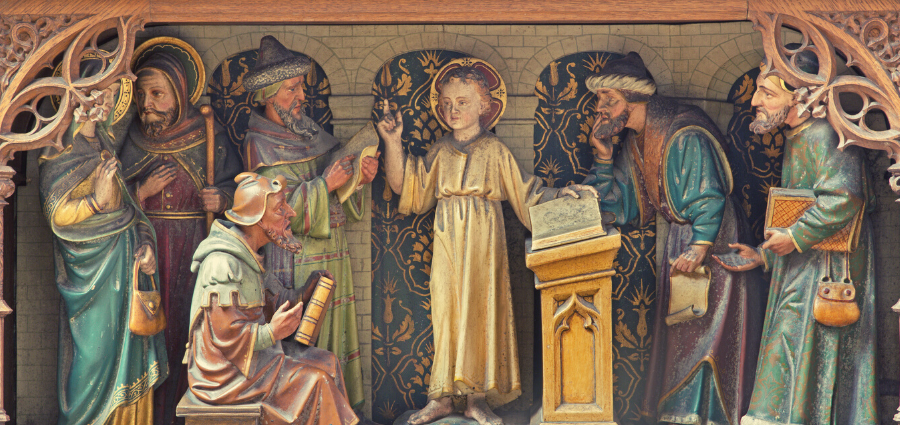
With that story in mind, we can compare it to the well-known Gospel account of the finding of the child Jesus in the temple. After their visit to Jerusalem, Mary and Joseph, along with a bevy of their family and friends, were heading home to Nazareth. They presumed that the child Jesus was somewhere among his relatives in this caravan. Instead, he was in the temple of the Lord, conversing with the elders and masters of the law. Distraught, Mary and Joseph spent three days looking for him.
Any parent who has ever searched for a lost child knows the anguish they must have felt. Can you imagine what it was like as they tried to sleep at night, spinning out the worst scenarios in their minds? When they finally find him, they, with understandable exasperation, upbraid him: ‘Son, why have you done this to us? Your father and I have been looking for you with great anxiety.’ But Jesus responds with a kind of devastating laconicism: ‘Why were you looking for me? Did you not know that I must be in my Father’s house?’ (Luke 2:48–49).
Both stories convey a truth that runs sharply counter to our sensibilities—namely, that even the most powerful familial emotions and sentiments must, in the end, give way to mission. Though they felt an enormous pull in the opposite direction, both Hannah and Mary let their sons go, allowing them to find their vocation in the temple—which is to say, in the space of God.
Legitimate sentiment devolves into sentimentality precisely when it comes to supersede the call of God. Both narratives disclose that, on a biblical reading, the family is, above all, the forum in which both parents and children are able to discern their missions. It is perfectly good, of course, if deep bonds and rich emotions are cultivated within the family, but those relationships and passions must cede to something that is more fundamental, more enduring, more spiritually focused. The paradox is this: precisely in the measure that everyone in the family focuses on God’s call for one another, the family becomes more loving and peaceful.
This biblical prioritization of values helps us to see, in fact, what typically goes wrong with families. When something other than mission is dominant—a son’s athletic achievement, a daughter’s success at university, a child’s emotional reliance on her parents, etc.—family relationships actually become strained. The father may be trying to work out his unfulfilled dreams through his son, which becomes the center of his preoccupations. All of his feelings, his passions, and his energies are focused now around the success of his son. Or the mother, out of pride, drives a daughter to perfection in all things, not for her good, but out of the mother’s self-regard. Or to maintain a superficial sense of peace, the dysfunctional behavior of children is left unaddressed. Sometimes this works the other way around: the children use their parents as a source of money or emotional security.
The point is that, ultimately, the family is the forum for the discovery and cultivation of one’s mission from God. John Paul II admirably summed up what I’ve been driving at when he spoke of the family as an ‘ecclesiola’ (a little church). At its best, he implies, the family is a place where God is worshiped and where the discernment of God’s mission is of paramount importance. I know it seems strange to say, but the most loving thing that family members can do is to let each other go—for God’s service.”
~Robert Barron

Comments